Revision Knee Replacement Surgery
What is Revision Knee Replacement Surgery?
Revision knee replacement is a complex procedure performed when a previous knee replacement develops problems such as persistent pain, instability, implant loosening, infection, bone loss, or fractures around the artificial joint. Unlike primary knee replacement, revision surgery requires a detailed understanding of why the first implant failed and a personalized strategy to restore stability, movement, and function.
This comprehensive guide explains the causes of failed knee replacement, how revision surgery is evaluated, the role of advanced diagnosis, modern pain management approaches, recovery expectations, and why choosing an experienced revision knee specialist is essential.
With more than 40 years of experience, more than 30,000 joint replacement procedures, 44+ scientific publications, and 8 international patents, Dr. Samih Tarabichi combines clinical expertise, research, and innovation in complex knee reconstruction and revision surgery.
Dr. Samih Tarabichi’s Research Foundation in Revision Knee Replacement:
Dr. Tarabichi’s scientific work focuses on understanding the challenges that affect knee replacement outcomes, including implant-related complications, hidden causes of pain, fracture patterns, soft tissue problems, pain management, and recovery enhancement.
| Patient Concern | Research Contribution | Clinical Importance |
|---|---|---|
| Why does a knee replacement fail? | Research on periprosthetic insufficiency fractures following total knee arthroplasty | Helps surgeons recognize uncommon fracture patterns around implants that may require complex revision reconstruction. |
| Why does my knee still hurt after replacement? | Research on tibial component rotation in painful total knee arthroplasties using MRI enhanced with metal artifact reduction techniques | Highlights the importance of identifying hidden implant-related causes of pain before considering revision surgery. |
| Can implant design affect complications? | Research on posterior stabilized total knee arthroplasty and postoperative periprosthetic fractures | Provides insight into how implant design and biomechanics may influence complications after knee replacement. |
| How are ligament problems managed? | Research on primary repair of iatrogenic medial collateral ligament injury | Demonstrates the importance of restoring soft tissue stability during complex knee procedures. |
| How can pain after surgery be improved? | Research on intraoperative cryo-neurolysis for enhanced pain management after total knee arthroplasty | Supports modern approaches designed to improve postoperative comfort and rehabilitation. |
| How can knee function and pain be optimized? | Research on BeFit Patelloplasty in total knee arthroplasty | Explores targeted approaches to improve patellar-related pain and functional outcomes. |
| How can recovery be enhanced after surgery? | Research on wound closure advances after total knee arthroplasty | Highlights the importance of every stage of recovery, from surgical closure to rehabilitation. |
| How can revision challenges be addressed through innovation? | U.S. Patent US11,134,958 B2 – Revision Joint Replacement Device and Method | Demonstrates contribution to implant technology and solutions for complex revision reconstruction. |
What Is Revision Knee Replacement Surgery and When Is It Needed?
Revision knee replacement is a surgical procedure performed to replace, revise, or reconstruct a previous knee replacement that is no longer functioning properly. Unlike primary knee replacement, where damaged joint surfaces are replaced for the first time, revision surgery involves working around an existing implant and addressing the reason why the previous replacement did not achieve the desired outcome.
According to the American Academy of Orthopaedic Surgeons (AAOS), revision total knee replacement may be required when problems develop after the initial surgery, including implant loosening, infection, instability, wear, stiffness, or fractures around the artificial joint.
The goal of revision knee replacement is not simply to replace the implant again. The objective is to identify the underlying cause of failure, restore knee stability and alignment, preserve remaining bone, reduce pain, and improve the patient’s ability to return to daily activities.
What Are the Main Reasons a Knee Replacement May Need Revision?
Revision knee replacement surgery is not automatically required for every patient experiencing pain or problems after a knee replacement. The decision to perform revision surgery depends on identifying the specific cause of the problem, assessing the condition of the implant and surrounding tissues, and determining whether surgical reconstruction can improve the patient’s function and quality of life.
According to the American Academy of Orthopaedic Surgeons (AAOS), the most common reasons for revision total knee replacement include implant loosening, infection, instability, wear, stiffness, and fractures around the knee implant. AAOS OrthoInfo – Revision Total Knee Replacement
Common reasons patients may need revision knee replacement
1. Implant Loosening
Over time, the connection between the implant components and the surrounding bone may weaken. Implant loosening can cause:
- Increasing knee pain.
- Reduced stability.
- Difficulty with walking or weight-bearing activities.
A revision procedure may be considered when loosening affects knee function or causes significant symptoms.
2. Infection After Knee Replacement
Although infection after knee replacement is uncommon, it is one of the most serious complications because it can affect the implant and surrounding tissues.
Evaluation may include:
- Blood tests.
- Imaging studies.
- Joint fluid analysis.
- Assessment of the implant condition.
Depending on the situation, treatment may involve infection management, implant removal, and revision reconstruction.
3. Instability After Knee Replacement
A stable knee replacement depends on accurate implant positioning and balanced surrounding ligaments.
Patients with instability may experience:
- A feeling that the knee is giving way.
- Difficulty walking.
- Reduced confidence during movement.
- Recurrent swelling.
Dr. Tarabichi’s research on primary repair of iatrogenic medial collateral ligament (MCL) injury highlights the importance of soft tissue stability in achieving successful knee replacement outcomes. Ligament problems can significantly affect knee function and may require specialized management.
4. Persistent Pain After Knee Replacement
Persistent pain is one of the most complex reasons patients seek evaluation after knee replacement. Importantly, pain does not always mean that the implant needs immediate replacement. A detailed assessment is required to identify the true source of symptoms.
Possible causes include:
- Incorrect implant positioning.
- Component rotation problems.
- Infection.
- Instability.
- Patellar-related problems.
- Scar tissue.
- Other conditions affecting muscles, nerves, hip, or spine.
Dr. Tarabichi and colleagues investigated one of the less obvious causes of pain after knee replacement: tibial component rotation. Their research evaluated painful total knee arthroplasties using MRI enhanced with metal artifact reduction techniques, demonstrating the importance of advanced evaluation when standard investigations may not explain persistent symptoms.
5. Periprosthetic Fracture (Fracture Around the Knee Implant)
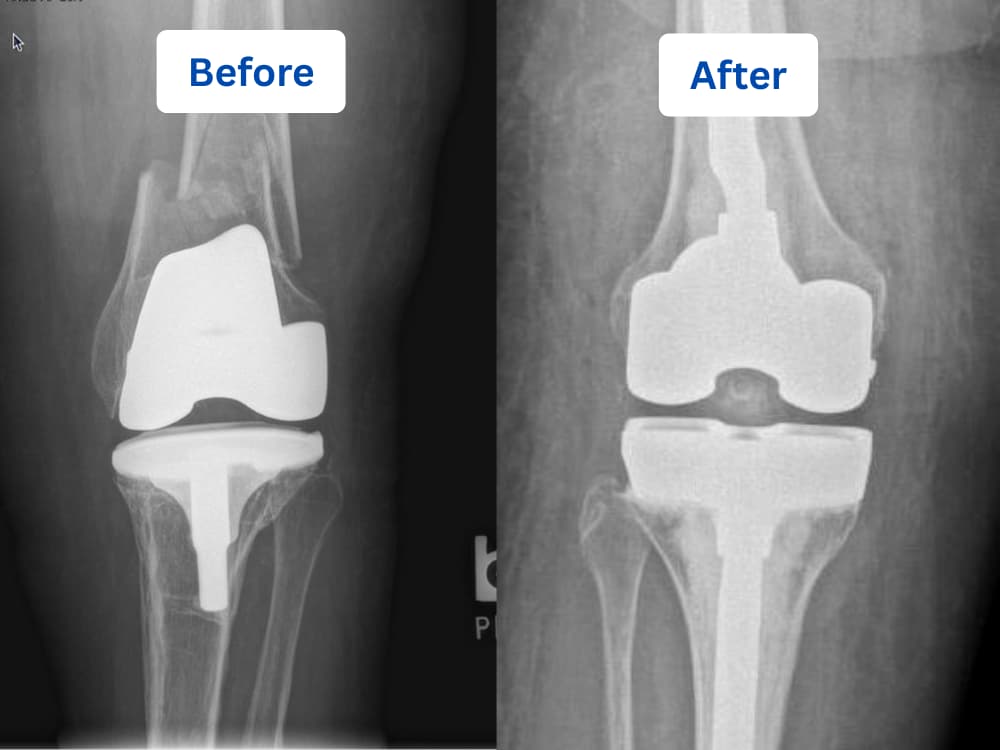
A fracture around an artificial knee joint, known as a periprosthetic fracture, is a serious complication that may affect implant stability and require complex revision surgery.
The management approach depends on:
- The location and severity of the fracture.
- Whether the implant remains stable.
- Bone quality around the implant.
- The patient’s overall health.
Dr. Tarabichi contributed to research describing a unique pattern of periprosthetic insufficiency fracture following total knee arthroplasty. This work contributes to the understanding of uncommon fracture patterns that may occur after knee replacement and require specialized revision planning.
6. Implant Wear or Damage
Knee implants are designed to provide many years of function; however, over time, wear of implant materials may contribute to:
- Inflammation around the joint.
- Bone loss.
- Reduced stability.
- Progressive discomfort.
Revision surgery may be considered when wear affects implant performance or causes damage to surrounding tissues.
Dr. Tarabichi’s research on posterior stabilized total knee arthroplasty and postoperative periprosthetic fractures also contributes to understanding how implant design and biomechanics may influence complications following knee replacement.
How does a Consultant decide if revision surgery is necessary ?
A revision knee Consultant will usually consider:
- The patient’s symptoms and functional limitations.
- Physical examination findings.
- Previous surgical history.
- X-rays and advanced imaging when needed.
- Laboratory tests to rule out infection.
- Implant position and stability.
- Bone quality and remaining bone stock.
The goal is not simply to replace an implant, but to understand why the knee replacement failed and create a personalized treatment plan to restore stability, movement, and function.
Why this matters when choosing a revision knee surgeon in Dubai ?
Because revision knee replacement addresses complex problems rather than a single condition, choosing an experienced specialist is critical. A surgeon with expertise in revision procedures should be able to diagnose different causes of failure, manage challenging reconstruction scenarios, and apply evidence-based techniques developed through clinical experience and research.
Dr. Samih Tarabichi’s scientific work in areas such as painful knee replacements, implant-related complications, and periprosthetic fractures reflects his focus on understanding and treating the challenges associated with complex knee arthroplasty.
In short:
Revision knee replacement surgery may be needed when a previous knee implant fails because of loosening, infection, instability, persistent pain, implant wear, or fractures around the implant. Before recommending revision surgery, an experienced knee specialist must identify the exact cause of failure through clinical assessment and appropriate imaging.
What Are the Preparation Steps?
The preparation process includes a detailed assessment of the patient’s medical history, knee condition, current medications, and overall health status. Appropriate imaging studies are reviewed to evaluate the extent of joint damage, alignment, and the condition of the surrounding structures of the knee.
Patients may undergo several preoperative assessments, including:
- Medical evaluation to identify and optimize any existing health conditions
- Anesthesia assessment to determine the safest anesthesia plan
- Blood tests and routine investigations required before surgery
- Review of current medications and any necessary adjustments before the procedure
Consequently, the team ensures that the procedure can be performed safely.
How Is Revision Knee Replacement Surgery Performed?
1. Comprehensive Preoperative Planning
Successful revision surgery begins before entering the operating room.
The surgeon evaluates:
- The reason the original knee replacement failed.
- Implant position and fixation.
- Bone quality and remaining bone stock.
- Ligament stability.
- Presence of infection.
- Patient expectations and functional goals.
Advanced imaging may be used when needed to understand implant position, bone condition, or hidden causes of symptoms.
2. Removal of the Previous Knee Implant
During revision surgery, the surgeon carefully removes the existing implant components.
This step requires precision because the goal is to:
- Remove failed components safely.
- Preserve healthy bone whenever possible.
- Minimize additional bone loss.
The complexity of implant removal depends on factors such as:
- How firmly the implant is fixed.
- The amount of bone surrounding the implant.
- Previous surgical history.
3. Treating Bone Loss and Preparing the Knee for Reconstruction
Bone loss is a common challenge in revision knee replacement.
Depending on the severity, the surgeon may use specialized techniques and revision implants designed to compensate for missing bone and provide stable fixation.
The reconstruction strategy may involve:
- Metal augments.
- Stems for additional fixation.
- Specialized revision components.
- Bone reconstruction techniques.
The objective is to create a stable foundation that allows the new implant to function properly.
4. Restoring Knee Stability and Alignment
A successful revision knee replacement depends on restoring:
- Correct limb alignment.
- Balanced ligaments.
- Stable movement.
- Appropriate implant positioning.
Soft tissue balance is especially important because ligaments control knee stability during walking and daily activities.
5. Implanting the Revision Knee Components
After preparing the knee, the surgeon places the revision implant components.
Revision implants are different from standard primary knee implants because they are designed to address more complex situations, including:
- Bone defects.
- Instability.
- Previous implant removal.
- Increased fixation requirements.
Dr. Tarabichi’s involvement in revision implant innovation includes U.S. Patent US11,134,958 B2 – Revision Joint Replacement Device and Method, reflecting his contribution to developing solutions related to complex joint reconstruction.
6. Closure and Recovery Planning
After the implant is placed and knee stability is confirmed, the surgical wound is carefully closed.
Recovery planning begins immediately, including:
- Pain management.
- Early mobilization.
- Physiotherapy.
- Wound monitoring.
- Progressive return to activities.
Optimizing every stage after surgery is important for successful recovery. Dr. Tarabichi’s work reviewing advances and challenges in wound closure after total knee arthroplasty highlights the importance of surgical techniques that support healing and recovery after knee procedures.
In short:
Revision knee replacement is a highly individualized reconstruction procedure. The surgeon’s role is not only to replace an old implant but to identify the cause of failure, rebuild a stable knee, manage complex tissues and bone conditions, and create the best possible environment for recovery.
For patients considering revision knee surgery, choosing a consultant with experience in complex reconstruction, advanced diagnosis, and evidence-based techniques is an important step toward achieving a successful outcome.
How Long Does Revision Knee Replacement Surgery Take?
The duration of revision knee replacement varies depending on:
- The reason for revision.
- Whether one or all components require replacement.
- The amount of bone reconstruction needed.
- Whether infection treatment is required.
- The complexity of the previous surgery.
Because every revision case is different, surgical planning is individualized rather than based on a fixed procedure time.
Robotic and Artificial Intelligence Systems: Available, Dr. Tarabichi uses robotic and AI technology when needed or requested by the patient.
What About the Pain Management?
Managing pain effectively after revision knee replacement surgery is an important part of recovery. Modern revision knee replacement care uses a multimodal approach that combines different strategies to reduce discomfort, support early mobility, and help patients participate effectively in rehabilitation.
Pain management may include:
- Preoperative pain planning
- Assessment of the patient’s medical history, pain level, and individual risk factors helps develop an appropriate pain control strategy before surgery.
- Multimodal pain management
- A combination of medications and techniques may be used to target pain through different pathways, reducing reliance on any single method.
- Anesthesia techniques
- Spinal anesthesia and other anesthesia approaches may be used according to the patient’s condition and surgical plan to improve comfort during and after the procedure.
- Cryo-neurolysis for postoperative pain control
- Dr. Samih Tarabichi’s publication “Enhanced Pain Management in Total Knee Arthroplasty: A Retrospective Analysis on Intraoperative Cryo-Neurolysis” evaluated the role of intraoperative cryo-neurolysis as part of pain management strategies, highlighting its potential role in improving postoperative pain control.
- Surgical techniques focused on knee function
- The management of structures around the knee can influence postoperative comfort and function. In “BEFIT Patelloplasty in TKA: A Targeted Approach to Improve Pain and Function,” Dr. Tarabichi presented a targeted approach to patellar management in total knee arthroplasty with the aim of improving pain and functional outcomes.
- Optimizing surgical technique
- Surgical factors can also influence recovery. Dr. Tarabichi’s research comparing tourniquet versus tourniquet-less techniques in total knee arthroplasty examined the effect of different surgical approaches on postoperative outcomes and recovery considerations.
Effective pain management is not only about reducing discomfort; it is also essential for enabling early movement, successful rehabilitation, and a smoother recovery after knee revision surgery.
What About Rehabilitation After the surgery?
Rehabilitation plays a vital role in achieving full recovery, therefore we established a comprehensive rehabilitation center for you
Specialized therapists guide patients through customized programs. These programs focus on restoring strength, flexibility, and mobility.
Furthermore, advanced rehabilitation equipment supports faster progress. As a result, patients regain pain-free movement efficiently.
Frequently Asked Questions About Revision Knee Replacement
Yes. Pain may be associated with the position of an implant component, even after infection and loosening have been excluded. A study co-authored by Dr. Samih Tarabichi evaluated 15 patients with persistent pain and identified internal rotation of the tibial component in 11 cases. These findings support assessing component rotation, but they do not mean that the same proportion applies to all patients or that every case requires revision surgery. Source: Study on tibial component rotation in painful knee replacements.
Yes. Specialized MRI techniques can reduce interference from metal implants when the medical team considers the examination appropriate. A study co-authored by Dr. Samih Tarabichi used these techniques to evaluate tibial component rotation in patients with unexplained pain and also identified fibrous bands within some knees. MRI may help clarify the cause of symptoms, but its findings must be considered alongside clinical examination and other investigations—not used alone to decide whether revision is necessary. Source: MRI evaluation using metal artifact reduction techniques.
Yes. Weakened bone may fracture under normal loading, causing an insufficiency fracture. A study co-authored by Dr. Samih Tarabichi described a compression-fracture pattern around knee replacements associated with poor bone quality and preoperative bowing of the knee. The absence of a fall therefore does not rule out a fracture. New or increasing pain deserves assessment to identify its cause and determine the appropriate treatment. Source: Study on insufficiency fractures following knee replacement.
Yes. Implant designs differ in how they provide stability and how much bone is removed during implantation. A study co-authored by Dr. Samih Tarabichi compared 600 primary knee replacements and recorded more postoperative fractures in the posterior-stabilized group than in the cruciate-retaining group. These findings help explain certain complications, but they do not mean that posterior-stabilized implants are unsuitable for everyone or that having one is itself a reason for revision. Source: Study on implant design and postoperative periprosthetic fractures.
Not always. A study co-authored by Dr. Samih Tarabichi examined repair of medial collateral ligament injuries occurring during primary knee replacement, reinforced with synthetic material without switching to a more constrained implant. The treated patients showed no instability during follow-up. However, the study did not investigate chronic ligament insufficiency after replacement, so its results cannot be generalized to every revision case. Treatment depends on ligament condition, bone support and knee stability. Source: Study on repairing medial collateral ligament injuries during knee replacement.
Pain relief cannot be guaranteed. A study co-authored by Dr. Samih Tarabichi evaluated intraoperative cryo-neurolysis during primary knee replacement and reported decreasing pain scores among participants. However, it excluded revision procedures and had no comparison group, so it does not establish effectiveness specifically for revision surgery. Its suitability can be discussed with the surgical team as part of an individualized pain-management plan. Source: Study on intraoperative cryo-neurolysis after knee replacement.
No single wound-closure method suits every patient. A review co-authored by Dr. Samih Tarabichi examined sutures, staples, tissue adhesives and combined techniques after knee replacement. It emphasized selecting an approach according to tissue condition, individual risk factors and the mechanical support the wound requires. The review informs discussions about wound care but does not establish one technique as superior for all revision knee-replacement patients. Source: Review of advances and challenges in wound closure after knee replacement.
That degree of bending cannot be promised after revision surgery. A study co-authored by Dr. Samih Tarabichi reported average flexion of approximately 140 degrees at five years, but it examined primary knee replacement using a specific implant design. Its findings therefore do not establish the movement patients can expect after revision surgery. Your movement goals should be discussed individually with your surgeon, rather than applying primary knee-replacement results directly to revision procedures. Source: Study on achieving deep flexion after primary knee replacement.
The References:
- Enhanced Pain Management in Total Knee Arthroplasty: A Retrospective Analysis on Intraoperative Cryo-Neurolysis. Elfekky M, Alsultan A, Adi MM, Aburezeq MNAA, Rajaeirad M, Tarabichi S. Journal of Orthopaedic Experience & Innovation. 2025. DOI: 10.60118/001c.136350.
- Befit Patelloplasty in TKA: A Targeted Approach to Improve Pain and Function. Elfekky M, et al. Journal of Orthopaedic Experience & Innovation. 2025;6(2). DOI: 10.60118/001c.141826.
- Comparing the Effect of Tourniquet vs Tourniquet-Less in Simultaneous Bilateral Total Knee Arthroplasties. Hasanain MS, Apostu D, Alrefaee A, Tarabichi S. The Journal of Arthroplasty. 2018;33(7):2119–2124. DOI: 10.1016/j.arth.2018.02.013.
- Evaluation of Tibial Component Rotation in Painful Total Knee Arthroplasties by MRI Enhanced with Metal Artifact Reduction Technique. Elkabbani M, Osman A, Helaly M, Tarabichi S. Journal of Musculoskeletal Research. 2021;24:2150012. DOI: 10.1142/S0218957721500123.
- A Unique Pattern of Peri-Prosthetic Fracture Following Total Knee Arthroplasty: The Insufficiency Fracture. Shahi A, Saleh UH, Tan TL, Elfekky M, Tarabichi S. The Journal of Arthroplasty. 2015. DOI: 10.1016/j.arth.2015.01.006.
- Posterior Stabilized Total Knee Arthroplasty Increases the Risk of Postoperative Periprosthetic Fractures. Elkabbani M, et al. Journal of Orthopaedics, Trauma and Rehabilitation. 2022;29:1–8. DOI: 10.1177/22104917221082317.
- Primary Repair of Iatrogenic Medial Collateral Ligament Injury During TKA: A Modified Technique. Shahi A, Tan TL, Tarabichi S, Maher A, Della Valle C, Saleh UH. The Journal of Arthroplasty. 2015;30(5):854–857. DOI: 10.1016/j.arth.2014.12.020.
- Achieving Deep Flexion After Primary Total Knee Arthroplasty. Tarabichi S, Tarabichi Y, Hawari M. The Journal of Arthroplasty. 2010. DOI: 10.1016/j.arth.2008.11.013.
- Knee Kinematics of High-Flexion Activities of Daily Living Performed by Male Muslims in the Middle East. Acker SM, Cockburn RA, Krevolin J, Li RM, Tarabichi S, Wyss UP. The Journal of Arthroplasty. 2011;26(2):319–327. DOI: 10.1016/j.arth.2010.08.003.
- Revision Joint Replacement Device and Method. Tarabichi S, Elfekky MM, inventors. U.S. Patent US11,134,958 B2.
Have a Question or Need an Appointment?
For appointments or inquiries regarding your treatment with Dr. Samih Tarabichi, kindly submit your inquiry below.