Minimally Invasive Hip Replacement
What is it ?
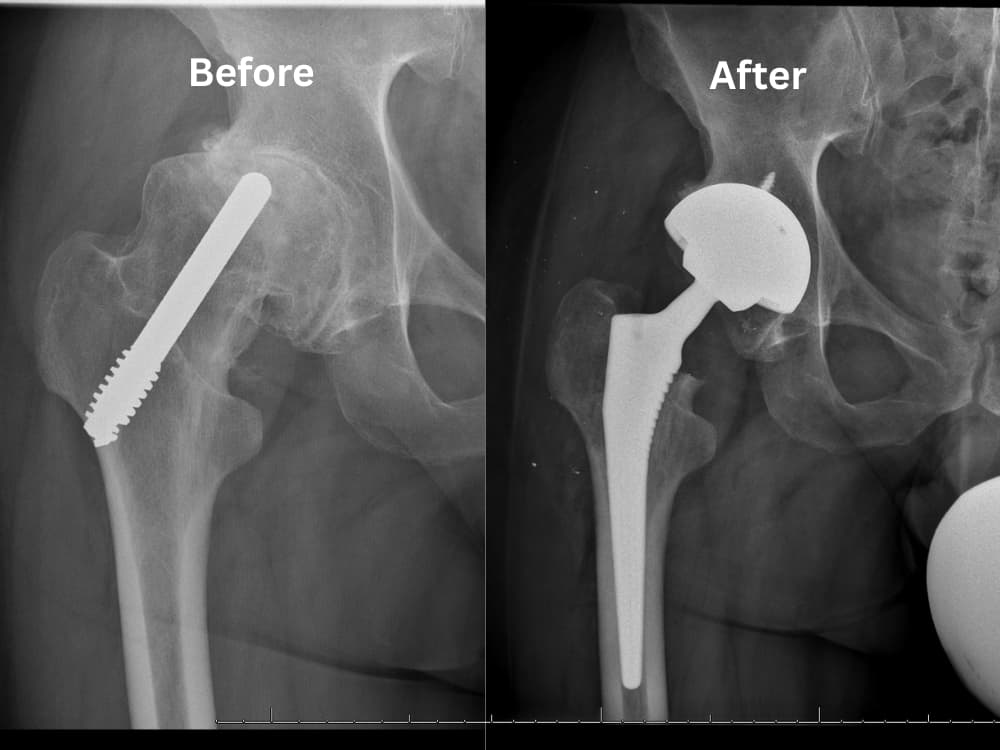
Minimally invasive hip replacement is a modern surgical approach focused on replacing only the damaged hip joint surfaces while preserving healthy surrounding tissues. The procedure is performed through a small incision of approximately 8–12 cm (3–5 inches), significantly minimizing muscle disruption and promoting faster recovery. Refined and advanced by Dr. Samih Tarabichi over many years of clinical expertise, the technique avoids cutting major muscles and tendons, maintaining the hip’s natural biomechanics. The damaged hip joint surfaces are carefully removed and replaced with a new joint constructed from advanced titanium and medical-grade ceramic materials, along with the insertion of an artificial cartilage layer. This highly durable joint design is engineered to provide superior longevity, often lasting longer than conventional artificial hip implants while delivering smooth, pain-free movement. The incision is then closed using specialized techniques designed to support rapid healing and early mobility. This innovative method ensures accuracy, long-term durability, and quicker return to normal activities, setting a new standard in modern hip arthroplasty
When the surgery is recommended?
There are several reasons why Dr. Tarabichi may recommend hip replacement surgery. Patients who benefit most from this procedure often experience: Severe hip pain or stiffness that limits everyday activities, including walking, climbing stairs, bending, or getting in and out of chairs and cars. It may become difficult to walk even short distances without significant discomfort, often requiring the use of a cane or walker. Moderate to severe hip pain while resting, whether during the day or at night, which interferes with sleep and overall quality of life. Chronic hip inflammation and swelling that does not improve with rest, medications, or conservative treatments. Hip joint deformity or reduced range of motion that affects posture, balance, and mobility. Failure to achieve sufficient relief from non-surgical treatments such as anti-inflammatory medications, cortisone injections, lubricating injections, physical therapy, or previous hip procedures.
Is it suitable for your age?
There are no absolute age or weight restrictions for total hip replacement surgery, recommendations for surgery are based on a patient’s pain and disability, not age. most patients who undergo total hip replacement are age 50 to 80, but Dr Tarabichi evaluate patients individually, total hip replacements have been performed successfully at all ages, from the young patients with juvenile arthritis to the elderly patient with degenerative arthritis.
What are the preparation steps for the procedure ?
Before the surgical procedure, the patient undergoes a comprehensive assessment by a specialist in internal medicine and an anesthesiologist. Extensive laboratory tests are conducted to evaluate most of the body’s vital functions to determine the feasibility of performing the surgery.
How its done?
There are three basic steps to minimally invasive hip replacement surgery:
- Prepare the joint: The damaged cartilage and worn surfaces of the hip joint are carefully removed from the femoral head (ball) and the acetabulum (socket), along with a minimal amount of underlying bone.
- Position the implants: The removed bone and cartilage are replaced with advanced titanium and medical-grade ceramic components that recreate the natural ball-and-socket structure of the hip joint. These components are either securely press-fit or fixed with medical cement for long-term stability.
- Insert the liner (artificial cartilage): A durable medical-grade liner is placed between the new joint components to ensure smooth, pain-free movement and reduce friction, restoring normal hip function.
Which Knee Implant Systems will be used?
Dr. Samih Tarabichi ensures the use of the best artificial hip joints available globally. These joints are made from biocompatible materials, with no reported cases of body rejection.
Several artificial hip joint systems have been developed worldwide to provide the most suitable joint for each patient, depending on the condition and degree of wear. At Dr. Tarabichi’s center for joint care, we offer all available options to provide the best care for patients. Examples of the surgical systems available include:
Cementless Hip Replacement System: Designed for patients with strong bone structure. This system is made from special materials that allow bone growth onto the implant, ensuring proper stability and restoring natural pain free movement.
Cemented Hip Replacement System: Suitable for patients with bone osteoporosis. The artificial joint is fixed using medical cement to restore natural pain free movement.
Custom 3D Hip Replacement System: The most advanced system currently available. It involves taking X-ray images of the natural joint according to a special protocol to accurately match the measurements of the patient’s natural joint. These measurements are sent to a specialized manufacturer in Switzerland to create a custom artificial joint, which is then installed to restore natural movement.
All artificial hip joints available at our center are designed and manufactured to closely mimic the natural human joint.
Robotic and Artificial Intelligence Systems: Available in the operating rooms, Dr. Tarabichi uses robotic and AI technology as needed or as requested by the patient.
What About the Pain Management?
Pain is an inherent part of any surgical procedure, and its intensity varies among individuals. We are committed to managing pain effectively and safely, avoiding addiction while ensuring the patient’s recovery is as swift as possible. Our approach includes:
Before Surgery: Based on the patient’s medical history, the most appropriate pain medications are prescribed. Cryotherapy is used several days before the surgery to target specific nerves around the knee responsible for pain. This procedure involves cooling these areas to numb the pain receptors, thus alleviating pain during the recovery period.
During Surgery: The preferred method is spinal regional anesthesia. This is supplemented with sedatives to help the patient relax and sleep during the procedure. This option typically has lighter effects on the body upon waking up.
After Surgery: A small PCA (Patient-Controlled Analgesia) pump is connected to the patient’s IV line, allowing them to control and administer the medication as needed. The medical team closely monitors the patient and provides appropriate medications during their hospital stay. Upon discharge, the patient is given suitable pain medications to aid in their recovery and help them during physical therapy until full recovery.
What About the Surgical Procedure and Recovery Period?
The Hip replacement surgical procedure typically takes about hour and half.
However, there is an additional preparation time in the operating room, which lasts approximately one hour. During the surgery, the latest equipment is used to ensure the procedure is performed safely.
After the surgery, the patient is transferred to the recovery room, where they stay for about an hour before moving to their hospital room or, if needed, to the intensive care unit for closer monitoring throughout the day.
Patients usually start walking with the assistance of a walker the next day after the surgery although some patients managed to walk few hours after the surgery. The hospital stay generally ranges from four to seven days, depending on whether one or both joints are replaced. During this time, the patient is closely monitored to ensure their safety, and appropriate medications are prescribed based on the patient’s condition.
Upon discharge, the patient receives specific instructions regarding wound care, follow up intensive physiotherapy program at our specialized center and home exercises. Patients can generally walk easily with the help of a walker after leaving the hospital.
What About the Follow Up Visits?
Post-hospital care and follow-up are essential parts of the recovery process. In addition to the customized two-month physical therapy program, our center provides a comprehensive follow-up plan, including periodic visits. The schedule is as follows:
One week after discharge: The first follow-up visit.
Monthly for three months: Subsequent visits to monitor progress.
Annually: An annual check-up.
During these visits, a clinical examination is conducted to assess the patient’s progress. The patient is questioned about their activities, such as walking, climbing stairs, sitting on the floor, and other daily tasks. X-rays are also taken to ensure that the new joint is functioning properly.
What About Rehabilitation After the Surgery?
Physical therapy is the essential phase that complements the surgical procedures, aiming to rehabilitate patients to achieve full mobility, such as kneeling on the ground. This is done under the supervision of highly skilled therapists in this field. Therefore, we advise patients to pay significant attention and commitment to the physical therapy program, which is specifically designed to meet each patient’s physical and functional needs.
To ensure the best possible recovery in the shortest time, we have provided the latest equipment in our physical therapy department. Our goal is to help patients regain muscle and ligament flexibility, strength and pain-free movements in the shortest period
What to Expect after the minimally invasive Hip replacement?
"Realistic activities following minimally invasive knee replacement include unlimited walking, swimming, golf, driving, light hiking, biking, ballroom dancing, and other low-impact sports"
The Video from the AAOS youtube channel
Frequently Asked Questions about Minimally Invasive Knee replacement Surgery
A. The patient has to pay attention to infections in the first year following the surgery.
Any surgeries performed shall be accompanied with wide-range antibiotics before and
after the surgery, even when it comes to dentistry. Also, the patient has to treat any
infections in the first year with wide-range antibiotics, to avoid any infection that will
spread to the joints.
A. Most patients are elderly, and many operations were performed for patients above 80 and 90 years successfully, while assuring their readiness to surgery before performance.
A. Most patients who suffer from chronic diseases such as diabetes & heart diseases have had surgeries performed successfully after referring them to the specialized physician for screening to obtain his approval for the surgery and 90 years successfully, while assuring their readiness to surgery before
performance.
A. Obesity complicates surgery, yet surgeries were successfully performed for patients who are above 100-140kg. It is rather challenging to ask the patient to lose weight, as his/her weight may increase difficulties in movement and cause decreased activity after surgery have had surgeries performed successfully after referring them to the specialized physician for screening to obtain his approval for the surgery and 90 years successfully, while assuring their readiness to surgery before performance.